
News Articles February 2026
Omics data on pituitary tumors catalogued
A recent study reviewed scientific studies on omics data generated in pituitary tumors. The data has been catalogued to make future research projects easier. Read more: https://www.eurekalert.org/news-releases/1114907
Pituitary cells and intracranial germ cell tumors
A new study looks at role of pituitary cells in the genesis of intracranial germ cell tumors, given that primordial germ cell-like cells reside in the pituitary. The authors call for more study. Read more: https://www.nature.com/articles/s41598-026-38060-2
Benefits of surgery for adrenal Cushing’s
An study in Lancet Diabetes and Endocrinology finds that surgery is more effective at controlling cortisol in patients with adrenal Cushing’s disease compared to a conservative management approach. Read the article in Cushing’s Disease News: https://cushingsdiseasenews.com/news/surgery-offers-best-cortisol-control-adrenal-cushings-syndrome/
Doctors say online influencers spread fear about cortisol
An article in the Associated Press looks at a trend online where influencers focus on the stress hormone cortisol. Some may raise people’s anxiety levels and push them to get unnecessary tests. Read more: https://apnews.com/article/cortisol-supplement-endocrinology-cushing-stress-0f6f6b8df2d11e2560d4e7562f522998
News Articles October 2024
New acromegaly drug on the horizon
A new drug for treatment and long-term maintenance therapy for acromegaly is now on the horizon. Crinetics Pharmaceuticals recently submitted its first new drug application (NDA) to the U.S. Food and Drug Administration for paltusotine, which is a once-daily oral selectively-targeted somatostatin receptor type 2 nonpeptide agonist.
Crinetics says researchers used data from from 18 clinical trials in the application, including two Phase 3 trials that evaluated paltusotine for acromegaly in medically untreated and treated patients. Patients tolerated the treatment well, the medication achieved biochemical control by maintaining IGF-1 levels and improved patients’ symptoms compared to placebo. The company says it expects to hear back from the FDA by December.
Paltusotine, is the first drug of its type to complete Phase 3 clinical development for acromegaly and is now in Phase 2 clinical development for carcinoid syndrome associated with neuroendocrine tumors. Read the company’s press release here.
Can machine learning to predict hormone deficiency after pituitary surgery?
A study featured on Nature.com used machine learning algorithms to predict whether patients would develop arginine vasopressin deficiency after transsphenoidal surgery to remove a pituitary adenoma. Read more here: https://www.nature.com/articles/s41598-024-72486-w
Pituitary apoplexy strikes groom on wedding day
An article in People.com tells the story of a groom in England who had to leave his wedding reception early due to a severe headache – one that turned out to be a hemorrhaging pituitary tumor. Read more here: https://people.com/groom-migraine-wedding-day-tumor-popped-8718083
Researchers try to make synthetic oxytocin for pain relief
An article in the Focus.news looks at efforts to replicate the hormone oxytocin in the lab – in an effort to develop a painkiller that would be safer than opioids. Read more here: https://www.thefocus.news/lifestyle/scientists-are-hoping-to-replicate-the-cuddle-hormone-for-healthy-long-term-pain-relief/
News Articles October 2024
New acromegaly drug on the horizon
A new drug for treatment and long-term maintenance therapy for acromegaly is now on the horizon. Crinetics Pharmaceuticals recently submitted its first new drug application (NDA) to the U.S. Food and Drug Administration for paltusotine, which is a once-daily oral selectively-targeted somatostatin receptor type 2 nonpeptide agonist.
Crinetics says researchers used data from from 18 clinical trials in the application, including two Phase 3 trials that evaluated paltusotine for acromegaly in medically untreated and treated patients. Patients tolerated the treatment well, the medication achieved biochemical control by maintaining IGF-1 levels and improved patients’ symptoms compared to placebo. The company says it expects to hear back from the FDA by December.
Paltusotine, is the first drug of its type to complete Phase 3 clinical development for acromegaly and is now in Phase 2 clinical development for carcinoid syndrome associated with neuroendocrine tumors. Read the company’s press release here.
Can machine learning to predict hormone deficiency after pituitary surgery?
A study featured on Nature.com used machine learning algorithms to predict whether patients would develop arginine vasopressin deficiency after transsphenoidal surgery to remove a pituitary adenoma. Read more here: https://www.nature.com/articles/s41598-024-72486-w
Pituitary apoplexy strikes groom on wedding day
An article in People.com tells the story of a groom in England who had to leave his wedding reception early due to a severe headache – one that turned out to be a hemorrhaging pituitary tumor. Read more here: https://people.com/groom-migraine-wedding-day-tumor-popped-8718083
Researchers try to make synthetic oxytocin for pain relief
An article in the Focus.news looks at efforts to replicate the hormone oxytocin in the lab – in an effort to develop a painkiller that would be safer than opioids. Read more here: https://www.thefocus.news/lifestyle/scientists-are-hoping-to-replicate-the-cuddle-hormone-for-healthy-long-term-pain-relief/
News Articles September 2024
Musician battles craniopharyngioma
An Irish DJ and music producer with the group Bicep named Matt McBriar is recovering after surgery for a large craniopharyngioma. Read more: https://www.msn.com/en-us/health/other/bicep-s-matt-mcbriar-treated-for-large-and-pretty-rare-brain-tumour/ar-AA1oLDvU?apiversion=v2&noservercache=1&domshim=1&renderwebcomponents=1&wcseo=1&batchservertelemetry=1&noservertelemetry=1
Social media obsession with “cortisol face” masks true pituitary origin
The term “cortisol face” is sweeping social media, with influencers claiming that stress causes high cortisol levels and leads to puffy cheeks, or “moon facies” that can be treated with diet, creams or lifestyle changes. But doctors say this is misinformation – and true moon facies come from a pituitary disorder. Read more: https://athletechnews.com/cortisol-face/
New study challenges link between cadaver growth hormone and Alzheimer’s
A new study raises objections to past research that linked cadaver-derived human growth hormone with Alzheimer’s disease. Read more: https://www.thetransmitter.org/alzheimers-disease/skeptics-challenge-claims-of-alzheimers-disease-transmission-via-growth-hormone/
Pituitary story: At ten years old, 6’3” boy battles gigantism
A story in the Daily Mail recounts the case of a ten-year-old boy from the U.K. names Jayson who stands 6’3” tall and battles pituitary gigantism. Read more: https://www.dailymail.co.uk/femail/article-13489681/rare-condition-harsh-realities-tallest-kid-world.html
Pituitary story: 62-year-old Indian man undergoes transsphenoidal surgery
An article in City Air news looks at the case of a man in India who had transnasal transsphenoidal surgery to remove a pituitary tumor. Read more:
News Articles August 2024
Pituitary story: Rare 7 cm Pituitary Macroadenoma
A story on The Health Site.com looks at the case of a 63-year-old woman in India who underwent transnasal transsphenoidal surgery to remove a 7 centimeter long pituitary macroadenoma. Read more here: https://www.thehealthsite.com/diseases-conditions/rare-large-tumor-removed-from-63-year-old-womans-pituitary-gland-1111633/
Spontaneous remission of Cushing’s in 14-year-old
A story in Cushing’s Disease News looks at the case of a 14-year-old South American girl with Cushing’s, whose disease went into remission after pituitary apoplexy. Read more: https://cushingsdiseasenews.com/news/rare-case-spontaneous-remission-cushings-disease-reported/
Schizophrenia and a Partially-Empty Sella
An article in Cureus looks at the case of a man whose schizophrenia worsened after 20 years, leading to the discovery of a partially empty sella. Read more: https://www.cureus.com/articles/267874-a-case-report-of-schizophrenia-with-a-partially-empty-sella-related-or-incidental#!/
Once-a-month injectable for acromegaly well-tolerated
The once-monthly octreotide subcutaneous depot finished a 52-week long-term safety study. Researchers found that patients tolerated the drug well and that the drug is was safe and boosted biochemical control. Read more: https://www.medpagetoday.com/endocrinology/growthdisorders/111212
More Articles
News Articles July 2024
Hormonal Disruptions and Pituitary Tumors An endocrinologist in India discusses the hormonal disruption experienced by pituitary patients. Read more:...
News Articles June 2024
Can machine learning improve diagnosis of hormone imbalance? A study in the journal Academic Radiology looks at the use of machine learning to analyze pituitary MRI images (radiomics) and clinical data – and finds it is helpful in the diagnostic process to...
News Articles May 2024
Does a form of dwarfism improve cardiovascular risk? A study in the Journal Med looks at the longevity of people with Laron’s Syndrome, who have low-growth hormone signaling that causes a form of dwarfism but may also confer lower risk of cancer and heart disease....
News Articles April 2024
PET/MRI and Cushing’s Disease A study in the Journal of Nuclear Medicine finds that PET/MRI may be more effective in diagnosing Cushing’s Disease compared to MRI alone Read more:Patient with hypothyroidism, Addison’s delivers twins An article in the Times of India...
News Articles March 2024
Comedian Amy Schumer battles Cushing’s Actress and comedian Amy Schumer revealed that she has been dealing with exogenous Cushing’s Syndrome, apparently triggered by steroid shots. Read more: Here is a Q and A about it from the University of Virginia: Read more:4th...
News Articles February 2024
Touch Endo Newsletter The latest newsletter from Touch Endo covers a range of topics, including research on diagnosing pituitary tumors, treating diabetes, lessening symptoms of menopause, and promoting liver health. Read more here: Banned Growth Hormone Linked...
News Articles January 2024
Woman diagnosed with pituitary tumor after nose, feet grow A woman in the U.K. ignored her fatigue and headaches for years, but saw a doctor after her nose and feet kept getting bigger. That led to the discovery of a pituitary tumor that had been present for 20 years....
News Articles December 2023
Effect of Antipsychotics on Prolactinoma Growth A study featured in Cureus looks the effect of antipsychotic medications on prolactinoma growth and found that when a patient stops taking risperidone, haloperidol, thioridazine, or amisulpride, prolactin levels in the...
News Articles November 2023
When an Ear Infection Turned Out to Be a Pituitary Tumor A story in the Daily Mail follows the case of a woman who visited her general practitioner for an ear infection and ended up being diagnosed with a pituitary tumor. Read more here: Study: Cushing’s More Often...
News Articles October 2023
Study: Pituitary Tumor Removal Surgery Safe in Patients over 75 An article in Express Healthcare Management looks at a study from France that found that surgery to remove a pituitary adenoma is safe for patients over age 75, with a low rate of complications. Read...
Available Now!
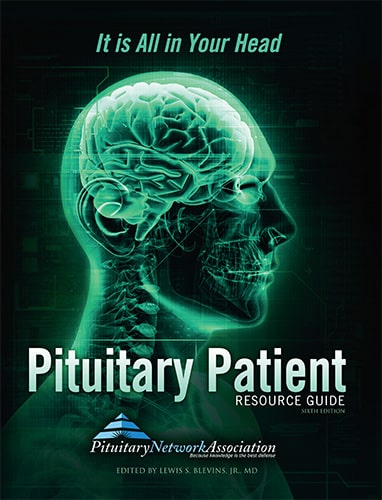
The Pituitary Patient Resource Guide Sixth Edition is now available! Be one of the first to have the most up-to-date information. The Pituitary Patient Resource Guide a one of a kind publication intended as an invaluable source of information not only for patients but also their families, physicians, and all health care providers. It contains information on symptoms, proper testing, how to get a diagnosis, and the treatment options that are available. It also includes Pituitary Network Association's patient resource listings for expert medical care.


Xeris Pharmaceuticals is valued member of the PNA